Kandersteg, Switzerland | August 18, 2026 | INFRAINTEL Bureau
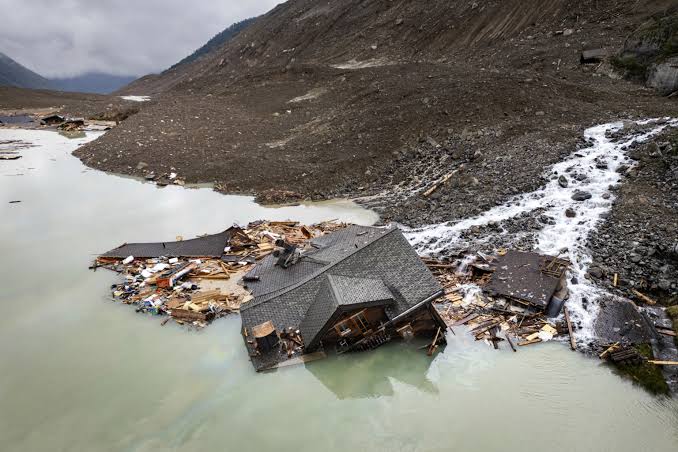
An unstable mountain formation overlooking Kandersteg in Switzerland’s Bern canton has raised concerns over the possibility of a major landslide, as rising temperatures continue to weaken glaciers and permafrost across the Alps.
Around 1,300 people live in Kandersteg, an Alpine village surrounded by steep valleys, glaciers and mountain peaks. Above the settlement lies an unstable rock formation known as Spitze Stei, which scientists and local authorities have placed under continuous observation.
Experts estimate that the unstable section contains approximately 15 million to 20 million cubic metres of material. A sudden collapse of the entire mass could cause a major natural disaster, although current assessments suggest that the formation is more likely to break apart gradually.
The situation has drawn comparisons with the May 2025 disaster in the nearby Lötschental valley, where a large mass of rock and ice descended from a glacier and covered most of the village of Blatten with debris and mud. The village had been evacuated before the collapse, limiting the loss of life.
Scientists have linked the growing instability of Alpine slopes to the melting of glaciers and permafrost. Permafrost acts as a natural binding material by holding together soil, sediment and fractured rock. When the ice melts, mountain slopes can become progressively unstable.
Markus Stoffel, a professor specialising in climate change and natural hazards at the University of Geneva, explained that melting underground ice weakens the material holding mountain formations together. This process is expected to increase slope instability in several parts of the Alps.
Residents of Kandersteg said they remained aware of the danger but were not living in constant fear because monitoring systems and evacuation plans were already in place. Locals also pointed out that stones had been falling from Spitze Stei for several years and that the situation differed from the sudden collapse at Blatten.
Authorities have prepared emergency and evacuation plans while experts continue to track geological movement. Such monitoring could provide advance warning if the rate of displacement increases or signs of a major collapse emerge.
Climate specialists have warned that landslides and avalanches could become more frequent as temperatures rise. In some locations, the cost of protecting infrastructure and settlements may eventually become so high that authorities could be required to reconsider the long-term habitability of vulnerable Alpine valleys.
The risk facing Kandersteg demonstrates how climate change is producing direct consequences for settlements, transport infrastructure and tourism economies in mountain regions. It also underlines the growing need for continuous geological monitoring, early-warning systems and climate-adaptation planning.